Friday, September 22, 2023

The Haunted History at the Old Jail in St. Augustine

*Originally published June 13, 2021 as a promotional piece. Some information may be missing.

 In 1878, oil magnate and industrialist Henry Flagler left New York with his ailing wife and headed to Jacksonville. On doctor's orders, they were advised to leave the climate of Manhattan for warmer, milder Florida so that Mary Flagler could try to recover from tuberculosis. Sadly, she didn't survive the trip. Shortly after her death, he remarried and moved about 35 miles further south to St. Augustine. He found the area beautiful and full of possibilities for tourism, but severely lacking in accommodations. He began making large real estate investments, including his flagship hotel, the Hotel Ponce de Leon (now Flagler College).

The city jail at that time was not only an eyesore, but it was within view from one of Flagler's hotels. He knew that his rich guests wouldn't want to see the jail while they were vacationing, and that its presence outside their hotel room windows could diminish their experience in such a charming city. Furthermore, he feared that such an unpleasant looking building would discourage his high profile friends from investing in St. Augustine. So, in 1891, Flagler contracted with the company that would eventually build Alcatraz to construct what is now known as the "Old Jail." It was built just north of downtown on San Marco Avenue, and disguised so as not to appear to be a jail from its outward appearance.

Listed in the National Registry of Historic Places, the jail was built to look like a hotel in the Romanesque Revival Style. It was painted an unassuming color. The walls were over 20 feet tall and so thick that no sound could transcend the cells and be heard by outside ears. Aside from the bars on the windows, no one passing by would ever have known it was a jail.


The conditions inside and what transpired within this beautiful Victorian building, however, earned the Old Jail its reputation as one of the most haunted spots in the city.

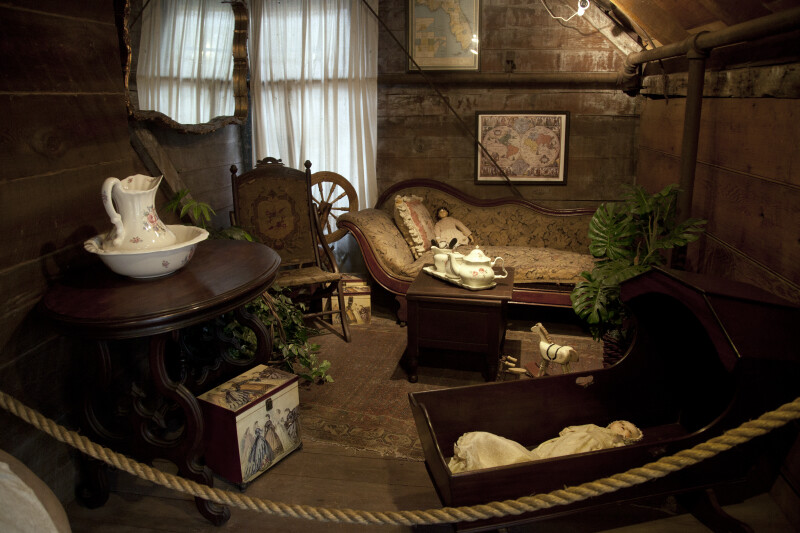
The jail not only housed both male and female inmates, it was also the home of the sheriff and his family. It was the city's only jail for more than 60 years, remaining open and operational until 1953.

While the sheriff's quarters were quite comfortable and well appointed with all the necessary comforts of the day for him and his family, the inmates' cells were a far cry from that. By today's standards, they would be considered unlivable for humans.


The windows didn't have any glass or protection from the outdoor elements - just the bars needed to prevent the prisoners from escaping.

The concrete and metal of the cells made for a very cold, very stern environment.

No blankets or pillows were provided. The mattresses were stuffed with Spanish Moss, so they were often infested with bugs. There were no bathing facilities or sanitation for human waste, so the inmates couldn't bathe and there was a constant stench that could not be eliminated.

The maximum security cells were located at the back of the building, equipped with stockades, a torture cell, and a clear view of the execution area. The solitary confinement cell didn't even have a bed.


There was much sickness and death in the Old Jail, far beyond the executions that took place there. There were eight reported hangings on the site, as well as many other unnatural deaths.

In truth, the inmates who were incarcerated there were the worst of the worst. Many did not survive their sentences. Although they were horrific people who had committed horrific crimes, the treatment they received at the hands of their jailers was often less than humane, including beatings, tortures, and starvation.

Paranormal researchers believe that these events caused the spirits of some of the inmates to linger within the Old Jail, resulting in the many mysterious and inexplicable events that happen today.

Some reported paranormal experiences include:


~ People who live near the jail as well as tour guests report hearing the sounds of footsteps walking around inside.

~ Visitors and workers have reported the aroma of sewage in the air although there is none to be found.

~ Although there are no longer any dogs living at the Old Jail, there are reports of dogs barking.

~ Tour guests have reported hearing voices in the cells and hallways, as well as the sounds of wailing and moaning coming from the maximum security and solitary confinement areas.

~ Some visitors have reported hearing the voice of a little girl coming from the sheriff's quarters.

~ There have been accounts of people people feeling like a cold hand is touching their shoulder, as well as the sensation that someone is pulling at their hair or blowing on them as they walk by.


Today, the Old Jail has been renovated to give tourists a glimpse into the daily lives of St. Augustine's most notorious prisoners and what it was like for them living under the penal system of the late 19th and early 20th centuries.

Costumed actors tell the stories of the jail and its inmates as you tour the space and examine the collection of weapons and artifacts. It is one of the few prisons of its kind still standing today. "The Old Jail After Dark" is a 45 minute experience that allows visitors to participate in an actual paranormal investigation at the Old Jail. Tickets are available at Old Town Trolley Tours.

If one of your reasons for visiting St. Augustine is the paranormal experience, like it is for us, this place needs to be on your list of tourist stops, and I would even recommend taking not only the daytime tour, but the "after dark" tour as well to get the full experience.


167 San Marco Ave.
St. Augustine, FL  32084

904-829-3800

Do you have any information or personal experiences to share about this entry? Let us know in the comments, and your contribution could be included in a future update to this entry!

St. Augustine Lighthouse & Maritime Museum

*Originally published June 14, 2021 as a promotional piece. Some information may be missing.

The St. Augustine Lighthouse and Keeper's House serve as both a scenic attraction and a maritime museum. Still an active aid to navigation on the North Florida coast, the Lighthouse and Maritime Museum is a private, non-profit museum dedicated to its mission "to preserve, present, and keep alive the stories of the Nation's Oldest Port as symbolized by our working St. Augustine Lighthouse."


Standing 165 feet above sea level, the Lighthouse overlooks the Atlantic Ocean and Matanzas Bay from Anastasia Island. Visitors can climb the 219 steps to the top of the Lighthouse for an incredible view of the city of St. Augustine and the ocean.

You'll have the opportunity to experience life at a Light Station through the exhibits at the Keeper's House, stroll through the grounds, check out the gift shop, or take a "Behind the Scenes" guided tour, included with admission.


"Behind the Scenes" tours are offered on the hour from 11am to 3pm every day. It showcases the important role the Light Station has played in St. Augustine's history, and provides a look at the research and preservation going on at the newly opened Maritime Archaeology and Education Center. The Museum itself is an American Alliance of Museums accredited institution, and a Smithsonian Affiiliate.

Additional specialty tours are offered, including the "Dark of the Moon" guided paranormal tour, the Lens Room Tour, and the Sunset/Moonrise dinner and drinks experience at the top of the lighthouse. Additional information and the opportunity to make reservations for any of the specialty tours is available on their website.

The St. Augustine Lighthouse has a long and storied history, beginning in the late 1500s when it was a simply a wooden watchtower used to protect the Spanish settlement from invaders and to direct Spanish ships and traders to their port. The simple flame atop the wooden tower was too weak to effectively signal ships, and served more as an accompaniment to the soldier on watch.


This first watchtower was burned to the ground by Sir Francis Drake during an attack in 1586.

It was nearly 100 years later, in 1683, when a coquina tower was build on the site from the ruins of a stone chapel. This first lighthouse, shown here, lasted 200 years until shoreline erosion caused it to fall into the sea in 1880. Due to the erosion, the current tower was built further inland in 1874, six years before the first tower fell.

The current Lighthouse is St. Augustine's oldest surviving brick structure. The Keeper's House that sits next to it was built in 1876 to provide living quarters for the families of those who kept watch, and now serves as the St. Augustine Lighthouse and Maritime Museum.


During World War II, the men and women of the Coast Guard trained in St. Augustine, and used the Lighthouse as a lookout post for enemy ships and submarines that frequented the coast.

After the war, during the 1960s, the Keeper's House was rented out to local residents, as there was no longer any need for a keeper to live on the grounds since the Lighthouse was fully electric and automated.

Over the decades following WWII, the Lighthouse unfortunately fell into disrepair, and in 1970 a fire nearly completely destroyed the Keeper's House.

In 1981, after years of neglect and vandalism, the Junior Service League of St. Augustine had the Lighthouse listed on the National Registry of Historic Places. They worked tirelessly to raise hundreds of thousands of dollars, financing a restoration effort that brought the Lighthouse and Keeper's House back to their former glory.

During its years of closure, the light continued to shine through the night, and after 14 years and $1.2 million toward restoration, including restoration of the original Fresnel lens, the St. Augustine Lighthouse and Maritime Museum is an impeccably beautiful example of Florida's maritime history.

Of course no story about such an historic location in St. Augustine would be complete without a ghost story or two, and the Lighthouse is no exception:

~ Peter Rasmussen, one of the first lighthouse keepers, was known for his love of cigars, and over the years, the smell of cigars has been detected by many staff members and guests.

~ Some claim to have seen and heard keeper Joseph Andreu at the top of the tower, the place where he fell to his death while painting the outside of the tower.

~ Perhaps the most well known ghosts of the Lighthouse were two young sisters who died on the property. Their father was hired to renovate the tower in the late 1800s. The girls were playing in a cart used to bring materials back and forth to the Lighthouse. When it broke loose, they weren't able to jump free in time and the cart slid quickly into the bay, plummeting both girls to a watery death. Since then, the girls can be heard laughing late at night, and some claim to have seen one of the girls wearing the same blue dress she died in.


~ Staff members often say they lock the door at the top of the tower each night before leaving, only to find it open when they arrive in the morning for work.

~ Staff also report chairs having been moved or overturned, as well as items from the gift shop being moved or missing only to reappear later.

~ Music boxes have been known to turn on by themselves.

There's so much more history to the Lighthouse than I've included here to be learned from a visit and tour. We personally love the paranormal tours, and though many of the "ghost tours" in St. Augustine are kid-friendly, the Museum recommends that for this particular paranormal experience, children under the age of 13 should not participate. 

Regardless which tour you choose, you should definitely check out this historic landmark while you're in the Old City.


100 Red Cox Drive
St. Augustine, FL  32080

904-829-0745


 Do you have any information or personal experiences to share about this entry? Let us know in the comments, and your contribution could be included in a future update to this entry!


The Oldest Wooden Schoolhouse in the USA

*Originally published as a promotional piece on June 16, 2021. Some information may be missing.

Dating back to the early 18th century the Oldest Wooden Schoolhouse is located at the north end of St. George Street in St. Augustine, not far from the City Gate. None of the wooden structures built in the city before 1702 still stand, because the British burned Spanish St. Augustine to the ground that year. As a result, the earliest property records for the schoolhouse date to 1740.


The original structure consisted of a one room, single story building with a detached kitchen, made of wood siding with a coquina chimney, where food was prepared for the family. Kitchens were commonly separate structures in those times, not only to keep the house cool during the hot summer months, but also to prevent any kitchen fires from spreading to the residential areas of the home.

The exterior of the house was made of bald cypress and red cedar bound together by wood pins and iron spikes, all made by hand.


In addition to the separate kitchen, there was a privy with a privacy wall and a well, all with easy access though the back door of the house. 

The garden area behind the hoe was used to grow vegetables, fruits, herbs, and spices. Water for cooking and drinking was drawn from the old well in this backyard garden space.

In 1768, the Minorcans, poor islanders from the Meditteranean, came to Florida as indentured servants on a plantation in New Smyrna. After 9 years enduring much mistreatment on the plantation, the survivors found refuge 70 miles north in St. Augustine during the British occupation of the city. They were allowed to settle on the north end of St. George Street just inside the City Gate, remaining there when the Spanish took the city again and when Florida joined the United States in 1821.

Jesse Fish, a land broker who represented the property interests of the fleeing Spanish officers and residents after the British took possession of Florida, sold the home to Juan Genopoly, a Minorcan refugee, on October 1, 1780.


Genopoly got married and established a homestead there, maintained by the Genopoly family for over a century.  He added a second story to the home for use as family living quarters, as well as an additional smaller room at the back of the first floor to serve as a family sitting room.

The main room of the house was transformed into a coed school in 1788, where Genopoly became its first teacher. He recognized the importance of learning English, and invited the children of the Minorcan Quarter to the school to learn reading, writing, and arithmetic.

Two of the four children born in St. Augustine to Juan Genopoly and his wife also taught at the old school. The last class at the school was in attendance in 1864.


Juan Genopoly was rather progressive for the times in which he lived, as the school was the first coed school in the United States, allowing attendance by boys and girls alike.

Visitors today can examine copies of old textbooks and school supplies from the 18th century, and tour the kitchen and gardens, where a bountiful pecan tree has been growing for an estimated 250 years.

From the front exterior on St. George Street, you'll see a large chain wrapped around the house attached to an enormous anchor. It was added in 1937 to hold the house in place in case of hurricane force winds and weather.

Recent maintenance has been done to replace the roof, among other fixes, but great care is always taken to maintain the authenticity of the schoolhouse.

As with nearly every one of the old structures in a city with so much history, there have been many reports of paranormal occurrences on the property. The old well in the garden has been the central figure of many strange happenings. Research through archival records have revealed stories of deaths and strange events on the property.

Ghost Tours of St. Augustine offers professionally guided paranormal investigations of the schoolhouse. We haven't gone on this tour yet ourselves, but every ghost tour we've enjoyed has included a stop by the Oldest Wooden Schoolhouse to detail some of its interesting history.


14 St. George Street
St. Augustine, FL  32084

904-824-0192

Do you have any information or personal experiences to share about this entry? Let us know in the comments, and your contribution could be included in a future update to this entry!

Ghosts of Kings Island

For those of you who didn't grow up in the Cincinnati area like me, Kings Island is a local amusement park in our area. Locals to the ar...